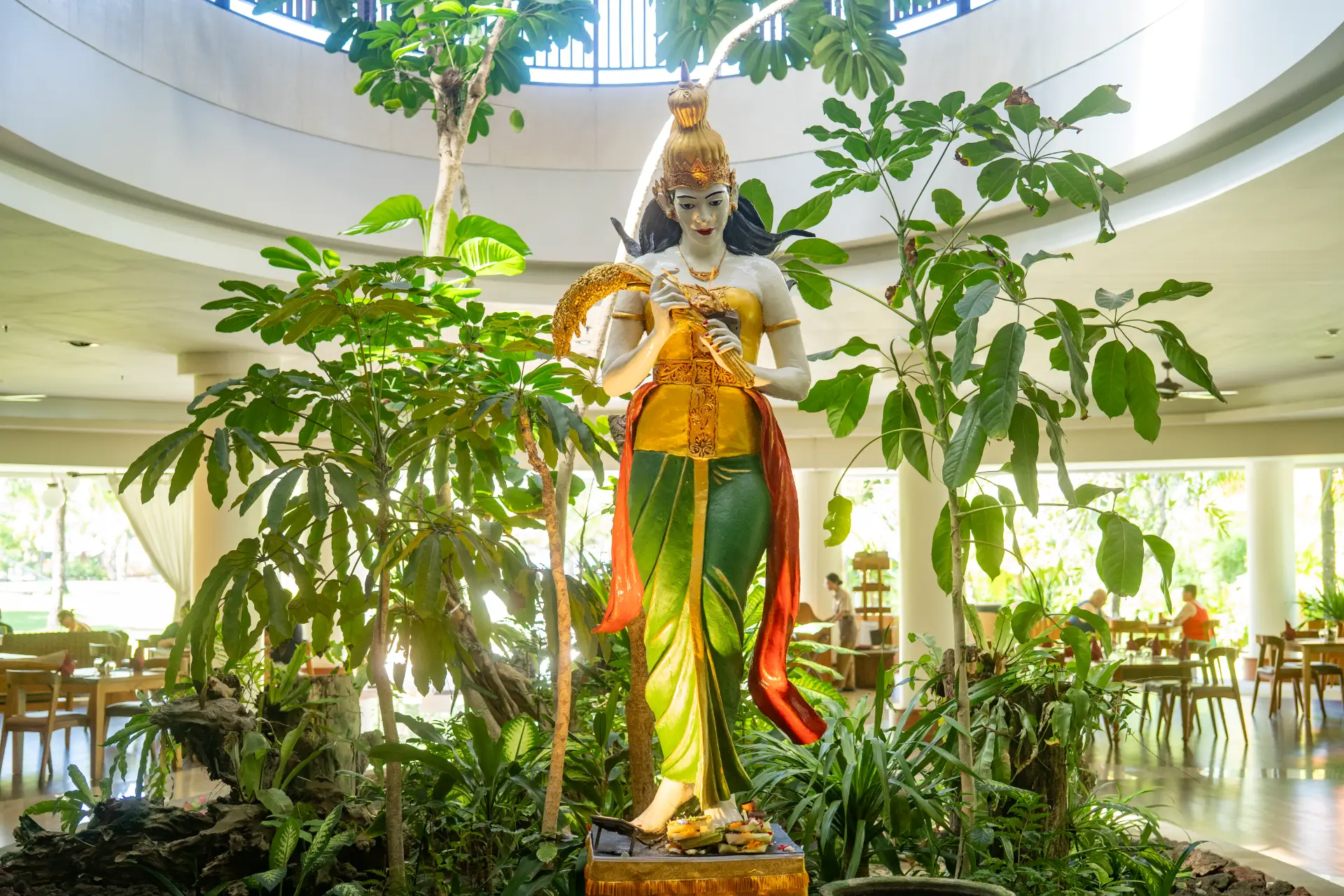
The story of Bhagawan Kasyapa, Goddess Kadru, and Goddess Vinata is one of the most well-known narratives in the epic tradition of the Mahabharata, particularly in the Astika Parva section. This legendary tale describes the origins of the Nāgas (serpent beings) and Garuda, while also carrying profound moral and ethical teachings.
The story begins when Bhagawan Kasyapa, a great sage, wished to bestow a blessing uponhis two wives in recognition of their exceptional devotion. He asked both of them to request whatever they most desired. Goddess Kadru asked to be granted one thousand powerful serpent children (Nāgas). Meanwhile, Goddess Vinata chose quality over quantity. She requested only two children, but with strength and abilities that would surpass all of Kadru’s offspring.
Bhagawan Kasyapa granted both requests. The eggs of Goddess Kadru hatched first, giving birth to thousands of serpents (such as Vasuki, Takshaka, and Anantaboga).
Seeing this, Goddess Vinata became anxious because her two eggs had still not hatched. Out of impatience and embarrassment, she forcibly broke one of the eggs.
From it emerged Aruna. However, because it was not yet time to hatch, Aruna was born with an incomplete body without legs below the waist.
One day, Goddess Kadru and Vinata saw the celestial horse Uchchaihshravas, the legendary white flying horse belonging to Lord Indra, as it crossed the ocean.
They argued about the color of its tail. Goddess Vinata was convinced that the entire body of the horse, including its tail, was pure white, while Goddess Kadru insisted that the tail was black. They eventually made a bet: whoever was proven wrong would become a slave and serve the winner for life. Realizing that her answer might be incorrect, Kadru resorted to deceit. She ordered her serpent sons to go that very night to the horse Uchchaihshravas and release their venom while clinging to its tail so that it would appear black.
Some of the serpent children refused, considering it an unethical act. Enraged, Kadru cursed her own disobedient sons, declaring that they would one day perish in a great serpent sacrifice (Sarpa Yajna) performed by King Janamejaya.Fearing their mother’s curse, the serpents eventually obeyed her deceitful command
The next day, when both goddesses went to examine the horse, the tail of Uchchaihshravas appeared pitch black, as it had been covered by thousands of small serpents.
Goddess Vinata, being honest and unaware of the deception, accepted her defeat. From that day onward, she became the slave of Goddess Kadru.
During this period of suffering and servitude, Vinata’s second egg finally hatched naturally. From it was born Garuda a magnificent half-human, half-bird being, radiant with power and brilliance like a blazing fire yet calm like the divine realm.
Garuda was deeply saddened to see his mother humiliated and forced to serve Kadru and the serpents wherever they went. Upon reaching maturity, he asked Kadru what he must do to free his mother. Kadru demanded an extremely difficult condition: Garuda must bring the sacred nectar of immortality, Amrita, from the realm of the gods in heaven.
Driven by pure devotion to his mother, Garuda accepted the challenge.
Garuda traveled to the heavenly realm (Kahyangan), defeated all the divine forces led by Lord Indra, and succeeded in seizing the sacred nectar of immortality, Amrita.
Garuda brought the Amrita to Goddess Kadru and the serpents. Before they could drink it, Garuda demanded that his mother, Goddess Vinata, be freed first. After Vinata was released, Garuda tricked the serpents by instructing them to purify themselves by bathing in a river before consuming the sacred nectar, so its power could be fully effective.
While the serpents went to bathe, Lord Indra returned and retrieved the vessel of Amrita back to heaven. However, a few drops had already spilled onto blades of sacred kusa grass. When the serpents returned and found the vessel gone, they licked the remaining drops of Amrita on the sharp grass. As a result, their tongues were split into two, becoming the defining characteristic of snakes to this day.
Through Garuda’s struggle, Goddess Vinata was finally freed from her curse and bondage, while Goddess Kadru had to accept the consequence that her serpent children would one day face a doomed fate due to the deceit she had sown.