In Hindu cosmology (including Balinese Hinduism), Dewi Saraswati is one of the most important and highly revered goddesses. She is the shakti (consort/manifesting energy) of Lord Brahma, the Creator.
Her primary role in the universe is as the Goddess of knowledge, wisdom, the arts, literature, and speech. Without the energy and knowledge of Dewi Saraswati, the process of creation by Lord Brahma would not be possible, and the world would fall into the darkness of ignorance (avidya).
Main Role of Dewi Saraswati: As the source of all knowledge—both scientific and spiritual she bestows wisdom upon humanity. This includes worldly knowledge (apara widya) for survival and practical life, as well as spiritual knowledge (para widya) for attaining liberation of the soul (moksha).
As the Protector of Arts and Culture: Dewi Saraswati is also worshipped as the goddess of aesthetics, beauty, and all forms of the arts (music, dance, painting, and literature). She serves as an inspiration for artists and poets in creating noble works.
She is also the ruler of speech and communication. The name “Saraswati” is derived from saras (flowing) and wati (she who possesses), meaning “she who has flowing essence.” She governs the flow of speech, eloquence, and truthfulness in communication.
Bringer of the Light of Peace: Through the knowledge she bestows, humans are able to distinguish between what is right (dharma) and what is wrong (adharma), thereby creating peace in the world.
Visual Symbolism in Statues or Images of Dewi Saraswati:
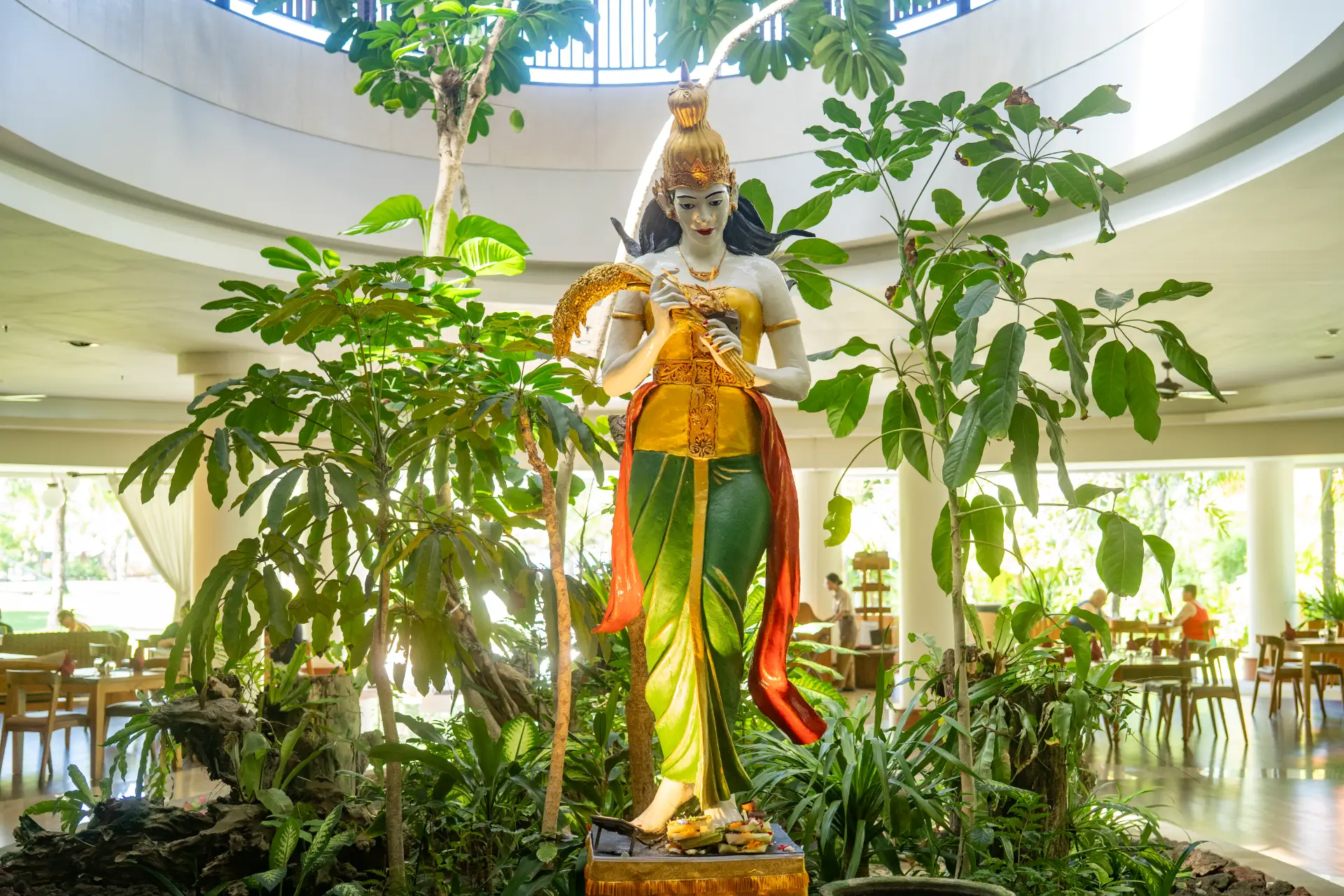
Dewi Saraswati is almost always depicted as an exquisitely beautiful and graceful woman with fair, radiant skin, dressed in white garments, and often shown with four arms, each holding a specific symbolic attribute. Every detail carries profound philosophical meaning:
- A Beautiful and Graceful Female Figure: This symbolizes that knowledge possesses a strong appeal it is beautiful, elegant, and deeply attractive to anyone who seeks it.
- White Attire: This symbolizes the purity of knowledge, which must not be tainted by ill intentions or human ego.
- Four Arms: These symbolize the four aspects of human personality involved in the learning process, namely: the mind (manas), intellect (buddhi), consciousness (citta), and ego (ahamkara).
Attributes in Her Four Hands:
- Sacred Texts (Keropak / Lontar Manuscripts): These symbolize concrete, written, universal, and eternal knowledge.
- Genitri (Hindu prayer beads): This symbolizes the continuous process of learning (spiritual cycle), meditation, self-discipline, and deep spiritual knowledge.
- Veena (traditional lute/sitar): This symbolizes art, culture, harmony of the mind, and the beauty of moral character that is in tune with nature.
- A single lotus flower (Padma) symbolizes ultimate truth. The lotus grows in muddy and dirty waters, yet its flower blooms clean and beautiful, representing that a knowledgeable person remains pure in the midst of a bad environment.
The vehicle of Goddess Saraswati near her feet, there are usually two animals carved as her mount
- The swan symbolizes the highest wisdom (wiweka). The swan is said to have the legendary ability to separate milk from water, or to feed in muddy waters without soiling its feathers. This symbolizes that a wise person is able to discern and filter what is good amid what is bad.
- The peacock symbolizes ego and worldly beauty. The graceful peacock near Goddess Saraswati represents the idea that human ego and pride in one’s knowledge must be tamed and controlled under the guidance of the goddess.
Tradition of Worshiping Goddess Saraswati in Bali
In Bali, Her role and blessings are specially celebrated every 210 days (on the day of Saniscara Umanis Watugunung), known as Saraswati Day. On this day, Hindus perform offerings to books, sacred scriptures, and lontar manuscripts as an expression of gratitude for the gift of knowledge. The following day (on Redite Paing Watugunung), the tradition of Banyu Pinaruh is carried out, where people go to springs or the sea to cleanse themselves physically and spiritually, seeking purification of the mind and hoping it is filled with the pure and flowing wisdom of Goddess Saraswati.