The tourism world in Bali, whose spirit is cultural tourism, also provides space for the arrangement of buildings inspired by traditional Balinese architecture. This concept is inseparable from the philosophy of Balinese life, which also serves as the foundation for tourism development philosophy, namely Tri Hita Karana.
Tri Hita Karana is a life philosophy or way of life aimed at achieving human happiness. In Hindu teachings, human life goals are described as Catur Purusa Artha, consisting of dharma, artha, kama, and moksha.
Tri Hita Karana is a timeless concept that remains highly relevant even in the digital era. It emphasizes the creation of three harmonious relationships in life: harmony between humans and God, humans and nature, and humans with each other, forming a balanced and peaceful living environment (Purwa Sidemen, 2022).
Jineng, based on literature on traditional Balinese architecture, is known by several names with similar functions as storage buildings, such as klumpu, jineng, and glebeg. These structures all serve as granaries used to store agricultural produce, especially rice.
Jineng is one of the important components within the spatial layout of a traditional Balinese compound. It features highly iconic architecture that reflects the philosophical values of Bali’s agrarian society.
In terms of structure and form, Jineng has a distinctive vertical composition, rising upward with a curved roof resembling a gunungan (mountain-like shape) or a semicircular arc typical of a granary form. Based on the concept of Tri Angga, its structure is divided into three main parts: the head (upper roof section), the body (main storage area), and the feet (supporting base structure).
- Nista Angga (lower part/foot section), consists of a foundation (batur) that is built slightly raised abovethe ground and supported by four main pillars (saka). In this lower area, there is a wooden platform (bale-bale) which is open and has no walls
- Madya Angga (middle/body section) is an enclosed upper space made of wooden planks. This room has a small door and miniature windows for air circulation so that the indoor temperature remains stable. To access it, a movable wooden ladder is used.
- Utama Angga (upper/head section) features a distinctive curved roof shape. In the past, this roof was required to be made from ijuk (palm fiber) or alang-alang (thatch grass) to maintain ideal humidity inside the structure. Around the upper pillars (before entering the main storage area of the Jineng), wooden or flat circular stone plates are usually installed, known as gegefar. These serve a very practical function: preventing rats from climbing up into the upper storage space.
The function of the Jineng is based on a highly efficient multifunctional concept that separates work activities from storage functions:
The upper part (enclosed space) serves as a “green gold barn,” a place for storing dried rice harvests. Due to its elevated position and carefully regulated air circulation, the rice stored here can last for years without rotting or being damaged by pests.
The lower part (open bale) functions as a social space and a daily work area. In this lower bale, homeowners typically use it for drying clothes, weaving (ngulat), socializing with family members, or resting after returning from the rice fields.
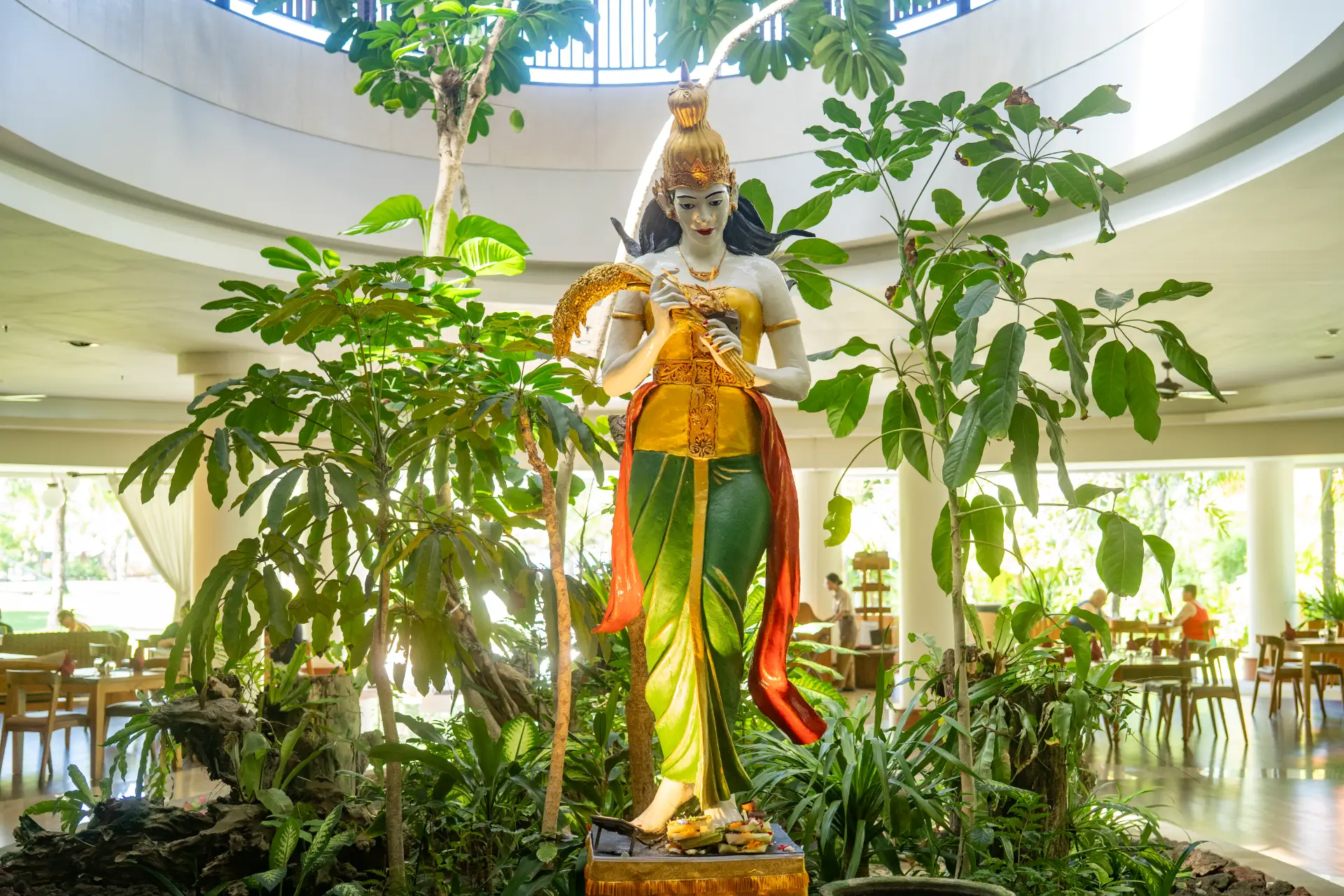
The jineng is not merely a place to store rice, but a symbol of the agrarian spirituality of Balinese society. As the stana (abode) of Dewi Sri, the jineng is believed to be the dwelling place or object of worship for Dewi Sri, the Goddess of fertility and prosperity in Hindu cosmology. Therefore, the jineng is always placed in the nista or madya area within the spatial layout of a household (near the entrance or kitchen), yet it is still treated with respect.
During every post-harvest ritual, offerings (sesajen) are always presented at this structure. As a symbol of food security and social status, a jineng filled with rice represents a family’s self-sufficiency in food. In the past, the jineng also served as a marker of social status; the larger and more solid the jineng owned by a family, the greater their rice field ownership and the higher their level of prosperity.